
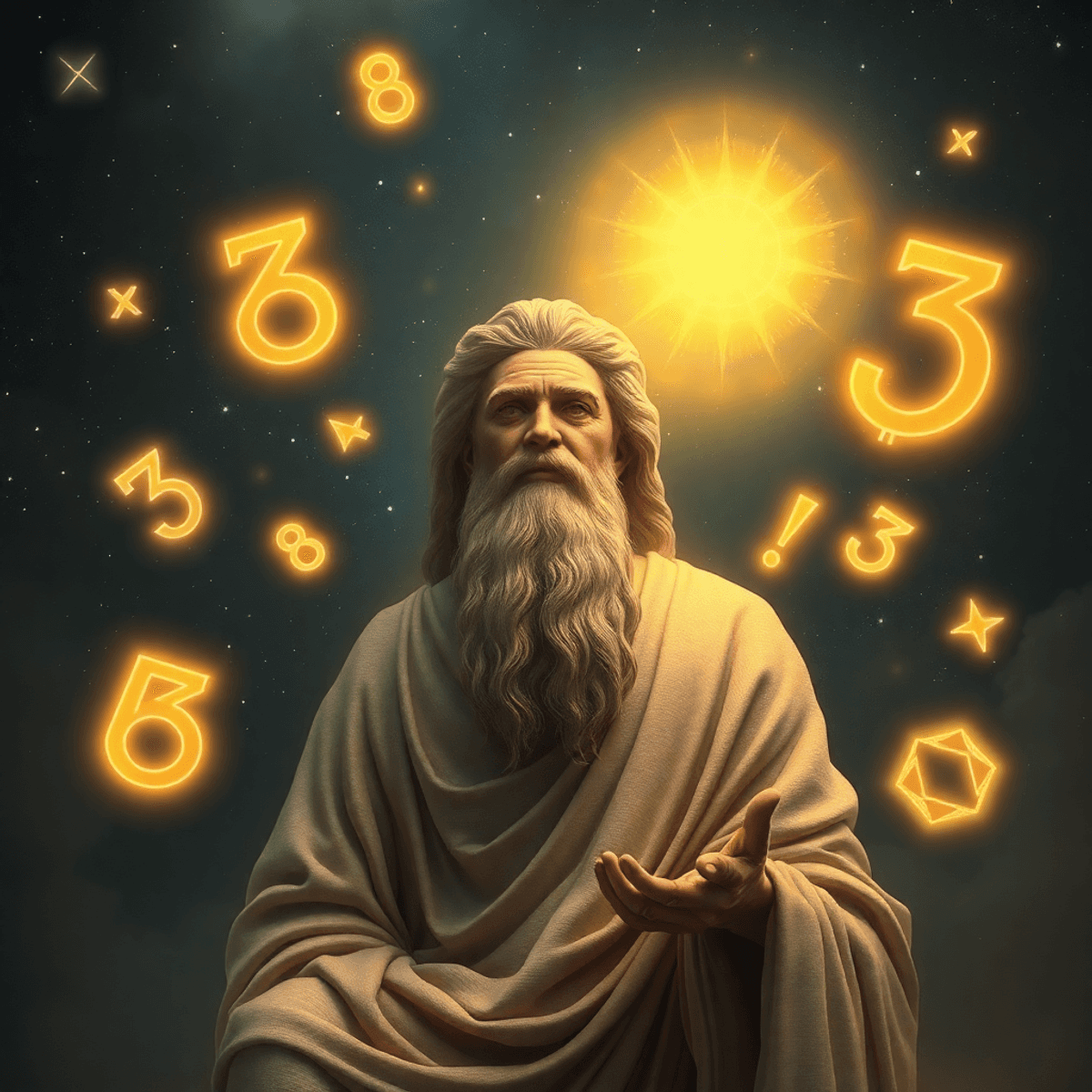
Numerology is the ancient practice of assigning symbolic and mystical meanings to numbers, believing they hold profound influence over our lives, personalities, and destinies. You might think of numbers as simple mathematical tools, but numerology transforms them into spiritual guides that reveal hidden truths about the universe and human existence.
Who is considered to be the first numerologist? This question takes us back thousands of years to ancient civilizations where numbers were revered as sacred symbols. The answer points to one remarkable figure whose teachings shaped how we understand the mystical properties of numbers today.
The origin of numerology stretches across multiple cultures and traditions. Ancient civilizations—from the Greeks to the Hebrews to the Arabs—all developed their own systems for interpreting numbers. These societies recognized that numbers represented more than quantities; they embodied cosmic principles, divine messages, and universal patterns.
When you explore Pythagoras numerology, you discover the foundation of modern numerological practice. This ancient Greek philosopher and mathematician stands as the first numerologist, credited with systematically linking numbers to spiritual and cosmic concepts. His revolutionary approach transformed numbers from mere counting tools into keys that unlock the mysteries of existence.
The journey to understanding the first numerologist reveals how ancient wisdom continues to influence contemporary spiritual practices and our relationship with the numerical world around us. Today, one can easily learn from a numerologist through various online platforms, which are gaining popularity as seen in several numerologist online reviews rankings. For those interested in pursuing this path professionally, there are opportunities available to become a certified numerologist.
Understanding Numerology: A Brief Overview
Numerology basics are based on the belief that numbers have spiritual and symbolic meanings beyond their mathematical uses. Practitioners use numerology to analyze numbers related to your birth date, name, or important life events in order to gain insights into your personality, destiny, and life path.
The practice is based on the idea that mystical numbers act as a universal language connecting the physical and spiritual worlds. Each number has its own unique vibrations and energies that affect human experiences and cosmic patterns. In numerology, numbers like 1, 7, or 11 are not just quantities—they represent fundamental forces that shape reality.
Through this ancient practice, we can uncover the secrets behind numbers. The history of arithmancy goes back to ancient civilizations where scholars and mystics first noticed connections between numerical patterns and natural events. The term “arithmancy” originally referred to the practice of assigning prophetic meanings to numbers. Ancient practitioners used these systems for various purposes such as:
- Predicting future events
- Interpreting dreams
- Understanding divine messages
- Making important decisions
These early numerologists saw numbers as keys to understanding deeper truths about existence. They believed that mathematical relationships represented cosmic order, and by studying these patterns, one could gain wisdom about the universe’s structure. This ancient practice laid the foundation for the complex numerological systems we have today.
Historical Roots of Numerology
Ancient numerology emerged from a rich tapestry of civilizations, each contributing unique perspectives on the mystical properties of numbers. These traditions developed independently yet shared a common thread: the belief that numbers held power beyond simple counting.
Greek Numerology: Understanding the Cosmos
One of the most influential branches of this ancient practice is Greek numerology. The Greeks didn’t just use numbers for commerce or measurement—they saw them as keys to understanding the cosmos. Their philosophers believed numbers represented divine order, with each digit carrying specific energetic qualities that influenced human life and natural phenomena.
Hebrew Gematria: Uncovering Hidden Meanings
In contrast, the Hebrew gematria system took a different approach by assigning numerical values to letters in the Hebrew alphabet. This practice dates back to ancient Jewish mystical traditions, where scholars calculated the numerical value of words and phrases to uncover hidden meanings in sacred texts. This wasn’t mere wordplay; practitioners believed these numerical relationships revealed divine messages and cosmic truths embedded within scripture.
Arabic Numerology: Bridging Cultures
Meanwhile, Arabic numerology developed its own sophisticated system, drawing from both mathematical advances and spiritual traditions. Arab scholars preserved and expanded upon ancient knowledge, creating complex frameworks that linked numbers to astrological influences and metaphysical concepts. Their contributions helped bridge Eastern and Western numerological practices.
Common Belief Across Cultures
These cultural origins shared a fundamental principle: numbers transcended their mathematical functions. Whether in Athens, Jerusalem, or Baghdad, ancient practitioners viewed numerical patterns as a language through which the universe communicated. They believed that by understanding these patterns, you could access deeper wisdom about existence, destiny, and the interconnected nature of all things.
Each tradition developed its own methodologies and interpretations, yet they all recognized numbers as vessels of meaning that connected the material world to spiritual realms. This cross-cultural reverence for numerical symbolism laid the groundwork for what would become a unified field of study.
Evolution of Numerology
Today, this ancient practice has evolved into various forms including professional numerology, where experts leverage these age-old principles to provide insights into personal lives or predict future events. For those interested in exploring this fascinating field further, there are numerous resources available online such as numerologist online platforms which offer personalized readings based on numerological principles.
Moreover, the financial aspect of being a numerologist can be quite rewarding as highlighted in this article about numerologist earnings. However, it is not just about financial gain; many practitioners delve into deeper aspects of numerology such as uncovering secrets through methods like dark crystal numerology, or providing predictions that leave people astounded as seen in this piece on numerologist predictions.
Pythagoras: The First Numerologist
Who Is Considered To Be The First Numerologist? The answer points directly to Pythagoras of Samos, a Greek philosopher and mathematician who lived from approximately 570 to 495 BCE. Born on the island of Samos in the Aegean Sea, Pythagoras traveled extensively throughout Egypt and Babylon, absorbing mathematical and mystical knowledge from these ancient civilizations. His journeys shaped his worldview and led him to establish a philosophical and religious school in Croton, southern Italy, where he gathered devoted followers known as Pythagoreans.
The Pythagorean philosophy extended far beyond conventional mathematics. While you might recognize Pythagoras from the famous theorem bearing his name, his true legacy lies in his revolutionary approach to understanding existence through numbers. He didn’t simply see numbers as tools for counting or measuring—he perceived them as the very essence of reality itself. This perspective transformed him into the founder of numerology as we understand it today.
Pythagorean Beliefs and Teachings
Pythagoras developed a comprehensive system connecting numerical values with cosmic order and universal harmony. His teachings proposed that everything in the universe could be reduced to numerical relationships. He observed mathematical patterns in music, discovering that harmonious sounds corresponded to simple numerical ratios. This revelation convinced him that numbers governed not just physical phenomena but spiritual truths as well.
The Pythagoras biography reveals a teacher who believed numbers held divine properties. He taught that specific numbers possessed distinct qualities and energies that influenced human life and the cosmos. His school operated as both an intellectual academy and a spiritual community, where members studied mathematics, music, astronomy, and philosophy as interconnected disciplines. They practiced strict ethical codes and believed that understanding numerical principles would lead to spiritual enlightenment and harmony with the universe.
Legacy of Pythagorean Philosophy
His approach created a bridge between the quantitative world of mathematics and the qualitative realm of mysticism, establishing the foundation for all subsequent numerological traditions. Today, anyone interested in exploring this fascinating field can become a numerologist themselves or utilize resources such as a numerologist calculator for predictions and insights. Moreover, understanding life path numbers can provide valuable insights into one’s personal journey, while learning about numerologist secrets related to specific numbers can uncover deeper meanings behind them. For those interested in exploring this field further, there are numerous numerologist reviews available online that can provide helpful guidance.
The Mystical Significance of Numbers According to Pythagoras
Pythagoras viewed numbers as the very fabric of existence itself. You need to understand that for him, numbers weren’t merely tools for counting or measuring—they were cosmic numbers that represented the underlying structure of all reality. He believed that everything in the universe could be expressed through numerical relationships, from the movement of celestial bodies to the harmony of musical notes.
The Pythagorean Number Symbolism System
The Pythagorean number symbolism system assigned specific qualities and characteristics to individual numbers:
- One: Represented unity and the source of all things, the divine origin from which everything emanated.
- Two: Symbolized duality and the principle of opposition—male and female, light and dark, good and evil.
- Three: Held particular importance as it represented harmony, wisdom, and the reconciliation of opposites.
- Four: Connected to justice and the four elements (earth, air, fire, water).
- Five: Represented marriage, combining the first female number (two) with the first male number (three).
- Ten: Called the “perfect number” or tetraktys, resulted from adding 1+2+3+4, and he believed it contained the entire nature of number itself.
You can see how Pythagoras believed three embodied completion because it had a beginning, middle, and end.
The Influence of Numbers on Music and Creation
He observed that musical intervals could be expressed as numerical ratios—the octave as 2:1, the fifth as 3:2, and the fourth as 4:3. This discovery proved to him that numbers governed even the most beautiful aspects of human experience, revealing a mathematical harmony that permeated all creation.
His followers would meditate on these numerical principles, believing that such contemplation brought them closer to divine truth and universal understanding. This aligns with how a numerologist today might interpret these ancient teachings to unlock secrets hidden within numbers.
Understanding Cosmic Order through Numbers
These esoteric meanings extended beyond simple symbolism. Pythagoras taught that understanding numerical relationships allowed you to comprehend the hidden order of the cosmos.
For instance, a professional numerologist can help unravel these cosmic mysteries by providing deeper insights into what numbers truly signify.
Furthermore, exploring these ancient beliefs provides an insightful perspective into how numbers shape our destiny, a concept deeply embedded in modern numerology.
Understanding this mystical significance could very well be seen as a journey through time, tracing back to Pythagorean teachings that continue to influence our understanding of numbers today.
The Development of Numerological Systems After Pythagoras
The evolution of numerology sped up as scholars and mystics from different civilizations built upon Pythagoras’s foundational work.
Greek Philosophers and Their Contributions
Greek philosophers who came after Pythagoras started documenting more complex connections between numbers and natural phenomena. They created detailed tables that showed how numerical relationships corresponded to planetary movements, musical harmonies, and human characteristics.
The Significance of Gematria in Hebrew Tradition
One of the most important advancements in the history of numerology was the practice of assigning numerical values to letters. This concept became particularly influential in the Hebrew tradition known as gematria. In gematria, each letter of the Hebrew alphabet was assigned a specific numerical value. By calculating the numerical sum of any word or phrase, practitioners believed they could uncover hidden connections between seemingly unrelated concepts. When two words had the same numerical value, it was thought that they possessed a mystical relationship or shared essence.
Greek Isopsephy and Its Impact on Analysis
Following a similar pattern, Greek isopsephy also assigned numbers to Greek letters. This system allowed scholars to analyze names, places, and sacred texts through a numerical lens.
Roman Adaptation and Its Influence on Western Numerology
The Romans took these methods and adapted them to their own alphabet, which laid the groundwork for what we now recognize as modern Western numerology.
Prediction through Numbers in the Medieval Period
During the medieval period, prediction through numbers became more advanced. Arabic mathematicians and mystics developed intricate systems that combined astronomical calculations with numerological interpretations. These practitioners used birth dates, names, and significant life events to forecast future outcomes and gain insights into personality traits.
Merging Philosophies in the Renaissance Period
The Renaissance period saw an increase in numerological texts that combined Pythagorean philosophy with Kabbalistic traditions. European occultists created comprehensive systems for divination, using numerical calculations to answer questions about love, career, health, and spiritual development.
Practical Applications of Numerology Today
Interestingly, this practical application of numerology can also be seen in areas like early childhood education. For example, Ms. Rachel’s first words learning experience incorporates elements of numerology by assigning numerical values to letters and words as part of the learning process.
You can trace the lineage of modern numerology directly to these developments after Pythagoras. What started as a simple concept of meaningful numbers grew into complex systems used for interpretation and prediction.
Comparing Pythagorean Numerology with Other Traditions
When exploring Who Is Considered To Be The First Numerologist, you’ll discover that Pythagoras wasn’t working alone. His system emerged alongside other rich numerical traditions, each offering unique perspectives on the mystical properties of numbers.
Pythagorean Numerology
Pythagorean numerology operates on the principle that numbers 1-9 carry distinct vibrational frequencies. You reduce larger numbers to single digits through addition, believing these core numbers reveal universal truths. The Greeks viewed numbers as abstract concepts representing cosmic order and harmony.
Hebrew Gematria
Hebrew gematria takes a different approach. You assign numerical values to Hebrew letters, allowing words and phrases to be analyzed through their numeric equivalents. This system became deeply embedded in Jewish mystical traditions, particularly Kabbalah. Where Pythagoras saw numbers as cosmic principles, Hebrew scholars used gematria to uncover hidden meanings in sacred texts.
Arabic Numeral Mysticism
Arabic numeral mysticism blended mathematical precision with spiritual insight. Islamic scholars developed abjad systems, similar to gematria but adapted to Arabic script. They used these calculations for everything from determining auspicious dates to interpreting the Quran’s deeper meanings.
The key differences in comparative numerology lie in their applications:
- Greek systems: focused on philosophical understanding and cosmic harmony
- Hebrew traditions: emphasized textual interpretation and divine revelation
- Arabic methods: combined practical divination with scholarly analysis
These traditions share common ground—all three recognized numbers as more than mathematical tools. They understood numbers as bridges between the material and spiritual realms.
Modern numerological practices draw from all three sources. You’ll find Pythagorean reduction methods combined with gematria-style letter assignments. Contemporary numerologists often incorporate Arabic techniques for timing and prediction. This synthesis creates the diverse landscape of numerology you encounter today, though Pythagoras’s foundational concepts remain central to most Western approaches.
Why Pythagoras Is Widely Regarded as the First Numerologist
Pythagoras is often called the first numerologist because he had a groundbreaking way of looking at numbers. Instead of just seeing them as tools for counting, he believed that numbers were alive and had deeper meanings. Historians and scholars agree that his organized method was the first serious attempt to understand the universe using numerical patterns.
The Influence of Pythagoras’ Teachings
Pythagoras didn’t just give meanings to numbers; he created a whole system where numerical connections explained everything, from music to the movement of planets. His ideas shaped how civilizations viewed reality and can be seen in various philosophical traditions throughout history.
Pythagoras’ Impact on Mathematics and Mysticism
Pythagoras’ teachings also laid the groundwork for modern mathematics and mysticism. His belief that “everything is number” established a philosophical basis for combining numerical analysis with spiritual practices. This approach influenced later systems of thought and continues to resonate today.
Interestingly, while Pythagoras was redefining our understanding of numbers, contemporary scientists were beginning to uncover the intricate relationship between numerical patterns and various aspects of human life, including health. For instance, the first warning signs of diabetes can often be identified through certain numerical indicators such as blood sugar levels. This intersection of numerology and health is a testament to the enduring legacy of Pythagorean thought in our understanding of life’s complexities.
Conclusion
Who is considered to be the first numerologist? The answer points directly to Pythagoras, whose revolutionary approach transformed numbers from mere mathematical tools into spiritual gateways. His origin summary reveals a philosopher who dared to see beyond calculations, recognizing that numbers held keys to understanding universal truths and cosmic harmony.
The importance of the first numerologist cannot be understated. Pythagoras established numerology as a spiritual discipline by weaving together mathematics, philosophy, and mysticism into a cohesive system. You can trace his influence through centuries of esoteric thought, from ancient mystery schools to contemporary spiritual practices.
His legacy in modern times remains remarkably vibrant. When you consult a numerologist today, calculate your life path number, or explore the meaning behind recurring number patterns, you’re engaging with concepts Pythagoras pioneered over 2,500 years ago. Modern practitioners still reference his core principles—that numbers possess inherent qualities and that understanding these qualities reveals deeper truths about existence.
The Pythagorean system continues to shape how we interpret numerical symbolism in personal development, spiritual guidance, and self-discovery. His vision of numbers as living forces rather than static symbols persists in countless numerological readings, books, and teachings worldwide. Pythagoras didn’t just study numbers; he gave them meaning that transcends time, creating a framework that helps you understand your place in the universe through the language of mathematics.
Leave a Reply